"Where the creature stops, there God begins to be...The smallest creaturely image that ever forms in you is as great as God is great...because it comes between you and the whole of God...But as the image goes out, God goes in...Go completely out of yourself for God's love, and God comes completely out of God's self for love of you. And when these two have gone out, what remains there is a simplifed One."
--Everything as Divine: The Wisdom of Meister Eckhart
I read Eckhart and my mind is nearly brought to a standstill. Just to try to intellectually grasp the meaning of his words is a challenge. The issue, of course, is that one must experience what Eckhart is trying to describe. Intellectually, it is so paradoxical and mysterious, the words just back one into an intellectual corner.
The "smallest creaturely image" that Eckhart describes seems to correspond with any thought or feeling in the mind that we grasp or turn away from. In other words, any phenomena that we take to be separate, unchanging and permanent, including elements of what we think of as our "selves." These "images" stand as a direct obstacle to awakening and realization of the Truth. But when we cease to grasp or turn away from these images, they are no longer obstacles, and the boundaries between me and not-me fade away. There is just the One.
As the Lenten season begins, may we all let go of that which separates us from the One.
Monday, February 27, 2006

Thursday, February 16, 2006
Beyond Why
 “If anyone went on for a thousand years asking of life: ‘Why are you living?” life, if it could only answer, would only say this: ‘I live so that I may live.’ That is because life lives out of its own ground and springs from its own source, and so it lives without asking why it is itself living. If anyone asks a truthful man who works out of his own ground: ‘Why are you performing your works?’ and if he were to give a straight answer, he would only say, ‘I work so that I may work.’”
— Everything as Divine: The Wisdom of Meister Eckhart, Sermon 5B
Eckhart was a Thomist, a thinker in the tradition of St. Thomas Aquinas. Everything has an essence, and its nature is to be what it is. The nature of Life is to be living; the nature of Being is to Be; the nature of Love is to Love. When we get past all the clinging and aversion within our minds, we arrive at our own essence, the “Ground” as Eckhart calls it here, which is the Ground of all things. And from this source, we don’t have to ask a lot of “why” questions. Things just are as they are.
This same Ground has been inspiring spiritual thinkers since the dawn of human awareness. Consider this passage from the second chapter of the Tao Te Ching:
Therefore the Master
acts without doing anything
and teaches without saying anything.
Things arise and she lets them come;
things disappear and she lets them go.
She has but doesn’t possess,
acts but doesn’t expect.
When her work is done, she forgets it.
That is why it lasts forever.
Wednesday, February 15, 2006
There is No Way
“It is out of this inner ground that you should perform all your works without asking, ‘Why?’ I say truly: So long as you perform your works for the sake of the kingdom of God…you are going completely astray…when people think that they are acquiring more of God in inwardness, in devotion, in sweetness and in various approaches than they do by the fireside or in the stable, you are acting just as if you took God and muffled his head up in a cloak and pushed him under a bench. Whoever is seeking God by ways is finding ways and losing God, who in ways is hidden. But whoever seeks for God without ways will find him as he is in himself.”
—Everything as Divine: The Wisdom of Meister Eckhart, Sermon 5B
I can’t read the medieval German in which Eckhart wrote these sermons, but I would love to know the German word for “ways” that he uses in this passage. The Meister seems to be giving sage advice about the tendency of spiritual seekers to get attached to particular methods (ways) of spiritual practice. We confuse the method for the outcome. As he notes, the Truth is just as easily revealed by the fireside and in the stable (in others words, in our normal, everyday, secular life) as in these pious spiritual practices.
The wonderful paradox of so much teaching from the monks, nuns and hermits of the contemplative tradition is that you don’t need to be a monk, nun or hermit to “get it.” In fact, that’s the essence of mysticism: the Divine is revealed in the ordinary, in everything, everywhere. There is nothing to “get.” It’s already here; it’s what we’re made of.
And how do we act when we see things just as they are? We are able, as Eckhart says, to perform our “works” without asking “Why?” Without an agenda for how things ought to be, we are able to respond to whatever this moment brings with clarity and spontaneity. As Zen Master Seung Sahn used to say, life is not complicated: “Green light, go.”
—Everything as Divine: The Wisdom of Meister Eckhart, Sermon 5B
I can’t read the medieval German in which Eckhart wrote these sermons, but I would love to know the German word for “ways” that he uses in this passage. The Meister seems to be giving sage advice about the tendency of spiritual seekers to get attached to particular methods (ways) of spiritual practice. We confuse the method for the outcome. As he notes, the Truth is just as easily revealed by the fireside and in the stable (in others words, in our normal, everyday, secular life) as in these pious spiritual practices.
The wonderful paradox of so much teaching from the monks, nuns and hermits of the contemplative tradition is that you don’t need to be a monk, nun or hermit to “get it.” In fact, that’s the essence of mysticism: the Divine is revealed in the ordinary, in everything, everywhere. There is nothing to “get.” It’s already here; it’s what we’re made of.
And how do we act when we see things just as they are? We are able, as Eckhart says, to perform our “works” without asking “Why?” Without an agenda for how things ought to be, we are able to respond to whatever this moment brings with clarity and spontaneity. As Zen Master Seung Sahn used to say, life is not complicated: “Green light, go.”
Sunday, February 12, 2006
The Birthing Ground
“As truly as the Father in his simple nature gives his Son birth naturally, so truly does he give him birth in the most inward part of the spirit, and that is the inner world. Here God’s ground is my ground, and my ground is God’s ground. Here I live from what is my own, as God lives from what is his own.”
—Everything as Divine: The Wisdom of Meister Eckhart, Sermon 5B
Meister Eckhart is considered one of the greatest stars in the constellation of Christian mysticism. Born around 1260 CE in Germany, he was even more thoroughly steeped in the medieval Christian worldview than the author of The Cloud of Unknowing, who followed Eckhart into the contemplative stream some century or two later. But Eckhart presents an understanding of spiritual experience far deeper than the conventional religious ideas of the Middle Ages.
Eckhart’s language is dense, mysterious and shot through with paradox. But what emerges from a careful study of his teachings is a rich experience of silent, meditative insight that blurs the boundaries between the contemplative practitioner and the Ultimate Reality, which Eckhart identified as the “Godhead.” This Godhead is not what we normally conceive of as “God.” Eckhart says our normal idea of God is but a feeble human attempt to understand something that can only be experienced.
Here, in Sermon 5B, Eckhart explains that the Christian teaching of the Incarnation is more than just an historical event. The Christ is born deep within the human spirit, and it is to this birthing ground that gives rise to Christ-consciousness that Eckhart draws our attention. And the startling revelation that emerges when we look into this inner landscape is that there is only oneness. The boundaries between the finite and Infinite vanish.
It is interesting to study Eckhart’s sermons alongside The Cloud of Unknowing. There is no evidence that the author of the Cloud was familiar with Eckhart and his teachings, but the parallels of experience they describe are striking. Whereas the Cloud describes a method, Eckhart focuses primarily on the experience that emerges when the method is put into place. The Cloud describes the pathway; Eckhart describes the destination.
—Everything as Divine: The Wisdom of Meister Eckhart, Sermon 5B
Meister Eckhart is considered one of the greatest stars in the constellation of Christian mysticism. Born around 1260 CE in Germany, he was even more thoroughly steeped in the medieval Christian worldview than the author of The Cloud of Unknowing, who followed Eckhart into the contemplative stream some century or two later. But Eckhart presents an understanding of spiritual experience far deeper than the conventional religious ideas of the Middle Ages.
Eckhart’s language is dense, mysterious and shot through with paradox. But what emerges from a careful study of his teachings is a rich experience of silent, meditative insight that blurs the boundaries between the contemplative practitioner and the Ultimate Reality, which Eckhart identified as the “Godhead.” This Godhead is not what we normally conceive of as “God.” Eckhart says our normal idea of God is but a feeble human attempt to understand something that can only be experienced.
Here, in Sermon 5B, Eckhart explains that the Christian teaching of the Incarnation is more than just an historical event. The Christ is born deep within the human spirit, and it is to this birthing ground that gives rise to Christ-consciousness that Eckhart draws our attention. And the startling revelation that emerges when we look into this inner landscape is that there is only oneness. The boundaries between the finite and Infinite vanish.
It is interesting to study Eckhart’s sermons alongside The Cloud of Unknowing. There is no evidence that the author of the Cloud was familiar with Eckhart and his teachings, but the parallels of experience they describe are striking. Whereas the Cloud describes a method, Eckhart focuses primarily on the experience that emerges when the method is put into place. The Cloud describes the pathway; Eckhart describes the destination.
Saturday, February 11, 2006
Here on the Way to There
 I've been reflecting a lot this last week on a conversation I shared with some family members last weekend about death and what comes after. I ended up going to the shelf and plucking off a book that I bought awhile back and never read, Here on the Way to There: A Catholic Perspective on Death and What Follows. It's by William Shannon, who is a Thomas Merton scholar and writer on the mystical/contemplative tradition within Christianity, and it has several interesting insights.
In the end, I don't think there's any need to try to "figure out" any of this. Sometimes we're tempted to think that when we die we're just dead and even if that's true, it doesn't really change much. I think that's one distinct possibility. But I think there are many other possibilities as well. The consensus of all the world's great religious and philosophical traditions is that reality is really just a flow of events (and that fact has enormous implications). Nothing is fixed and unchanging, and there is no reason to assume that the flow stops when we're dead. In fact, to assume that it does is perhaps the pinnacle of arrogance and conceit: we think we've figured out the universe, including what happens (or does not happen) when we die.
All of these possibilities are just conceptual overlays we try to impose on an experience that is too big to be contained in any belief or description. Where does that leave us? Open to any possibility. This is not just a philosophical position, but a way of being: open to whatever arises in the next moment, without clinging to what just was, without aversion to what is emerging, without any idea of what should be. Just completely open. This, to me, is faith.
Faith is not certainty of belief. It is quite the opposite. Faith is that complete and total letting go into whatever comes next, without needing to manipulate our experience in any way. This is the way I want to live, and the way I want to die. And if I do, then any idea I have about what happens afterward is just an amusing fantasy, perhaps an artistic imagining of possibility, sometimes helpful but not of any eternal consequence.
My prayer (affirmation) for myself and for everyone is that we might meet each moment, including the moment of death, with such absolute freedom and openness of heart.
Tuesday, February 07, 2006
Direct Looking
"‘Direct path’ teachings are really aimed at those who are spiritually ready. And being spiritually ready doesn’t really have anything to do with your spiritual resume...By readiness I mean we are ready to go to the core, we are ready to go to the root of the cause of suffering, the elimination of suffering, and the nature of what we really are. The direct path teachings are not for everybody. They are in stark contrast with the way we are used to dealing with things. To go the root of problems is not so much to deal with the problem, because the direct path doesn’t really tell us what to do about [problems]. They are really not about managing our conditioned self; they investigate who it is that actually suffers."
--Adyashanti, Spontaneous Awakening
Adya elaborates on this point elsewhere in the audio retreat that makes up Spontaneous Awakening. The direct path is sometimes viewed in contrast with more gradual pathways to awakening, which focus on moving into ever-deeper stages of insight and understanding until all identification with the local self drops away, and we see the Truth of What Is. However, there is a risk in using this kind of language (like using any language) that we begin to absolutize these terms. There are not really two paths.
The essence of this teaching is that moments of total, unpartial awakening are available to us all the time. Which is not to say that we don't slip back into the trance of thinking there is a separate self (taking our "selves" seriously, if you will). But once you have seen the self for what it is, even if you momentarily zone out again, you won't ever be the same. Every time awareness arises again, the truth of selflessness and interconnection will be clear.
Adya is trying to get us to stop the habit of "spiritual bypassing," or trying to use spiritual practice to "deal" with ourselves, as if there was ultimately a problem to be dealt with. This is the most fundamental way in which his path is "direct." We drop all the mental manipulation and obsession with our problems to look directly at what it is that is doing the manipulating, what it is that is obsessed. What is revealed puts all the other business (direct/indirect, problems/solutions) into proper perspective.
--Adyashanti, Spontaneous Awakening
Adya elaborates on this point elsewhere in the audio retreat that makes up Spontaneous Awakening. The direct path is sometimes viewed in contrast with more gradual pathways to awakening, which focus on moving into ever-deeper stages of insight and understanding until all identification with the local self drops away, and we see the Truth of What Is. However, there is a risk in using this kind of language (like using any language) that we begin to absolutize these terms. There are not really two paths.
The essence of this teaching is that moments of total, unpartial awakening are available to us all the time. Which is not to say that we don't slip back into the trance of thinking there is a separate self (taking our "selves" seriously, if you will). But once you have seen the self for what it is, even if you momentarily zone out again, you won't ever be the same. Every time awareness arises again, the truth of selflessness and interconnection will be clear.
Adya is trying to get us to stop the habit of "spiritual bypassing," or trying to use spiritual practice to "deal" with ourselves, as if there was ultimately a problem to be dealt with. This is the most fundamental way in which his path is "direct." We drop all the mental manipulation and obsession with our problems to look directly at what it is that is doing the manipulating, what it is that is obsessed. What is revealed puts all the other business (direct/indirect, problems/solutions) into proper perspective.
Friday, February 03, 2006
The "nothing" that is there
“Behind this dog and pony show called ‘me’ there is the ‘nothing’ that is there. And everything is about avoiding the nothing that is there. Hell, ninety-nine percent of spirituality is about avoiding the nothing that is there. It’s dressing it up, putting somebody else’s face on it, lighting incense to it, singing to it…doing everything but to actually, experientially fall in to the nothing that is there behind the mass called you and me. Only by letting go into that do we find out what we really are, so that in the end we find out we really are the nothing that is there.”
--Adyashanti, Spontaneous Awakening
This kind of language, if taken seriously, tends to scare the hell out of people. My experience is that when most people first come in contact with the teaching of no-self, they are absolutely petrified by the implications. This was certainly my reaction, and even now when I peer deeply into the emptiness at the center of my own being, the ego still shudders a bit at first in recognition of its own transient nature. Adya makes an excellent point about the ways in which spirituality helps us avoid our true nature. We have this deep intuition of our nothingness, but instead of looking at it we objectify the nothingness into something we can worship, and therefore something that is not really a part of us. This makes it less threatening to our egos.
Our egos, that part of us that we take to be “me” and “you,” are very, very real. We misunderstand the teaching of no-self when we think that we are saying the personality and our bodies and our memories, etc., are illusion. They are very real. But they do not exist as independent entities separate from other egos. All of reality is an interwoven tapestry of experiences. “Emptiness” or “no self” is another way of recognizing this. Where “I” end and “you” begin is not a real boundary. The sense of separation is a result of our limited understanding. The “nothing” that Adya describes is that lack of boundary we discover when we bring pure awareness to our experiences. He could just as easily have said “everything.” Only by letting go do we find out what we really are, so that in the end we find out we are really “the everything” that is there.
--Adyashanti, Spontaneous Awakening
This kind of language, if taken seriously, tends to scare the hell out of people. My experience is that when most people first come in contact with the teaching of no-self, they are absolutely petrified by the implications. This was certainly my reaction, and even now when I peer deeply into the emptiness at the center of my own being, the ego still shudders a bit at first in recognition of its own transient nature. Adya makes an excellent point about the ways in which spirituality helps us avoid our true nature. We have this deep intuition of our nothingness, but instead of looking at it we objectify the nothingness into something we can worship, and therefore something that is not really a part of us. This makes it less threatening to our egos.
Our egos, that part of us that we take to be “me” and “you,” are very, very real. We misunderstand the teaching of no-self when we think that we are saying the personality and our bodies and our memories, etc., are illusion. They are very real. But they do not exist as independent entities separate from other egos. All of reality is an interwoven tapestry of experiences. “Emptiness” or “no self” is another way of recognizing this. Where “I” end and “you” begin is not a real boundary. The sense of separation is a result of our limited understanding. The “nothing” that Adya describes is that lack of boundary we discover when we bring pure awareness to our experiences. He could just as easily have said “everything.” Only by letting go do we find out what we really are, so that in the end we find out we are really “the everything” that is there.
Wednesday, February 01, 2006
What you really are
“To look into our own true nature is very intimate. This isn’t about following somebody else’s story, it’s very much about you…How do I look at what I am? And then you see everything you keep taking yourself to be. What are my stories about myself? Only when you start looking this way can you see that everything you take yourself to be is not completely intimate. Because there’s always something closer, there’s something noticing: Oh, I take myself to be this and this and this. ‘Well, I feel such and such a way.’ Okay, that’s what you feel. What is it that feels such and such? You can’t answer that in your head. See, it gets very quiet.”
--Adyashanti, Spontaneous Awakening
This is the method of self-inquiry that Adyashanti teaches, alongside Awareness meditation. Though he presents them as two things, they are really one. Awareness is just deep looking to see what it is there. When awareness is applied to the landscape of the mind, it’s what Adya calls “self-inquiry.” It’s looking to see what is looking. And what is looking turns out not to be who you thought: it’s not your “personality” or any of the things you “take yourself to be.” It’s just wide open, infinite space. It’s the primordial silence. This is who we truly are, and from this space there can be no limitation, no grasping or aversion, no fear.
--Adyashanti, Spontaneous Awakening
This is the method of self-inquiry that Adyashanti teaches, alongside Awareness meditation. Though he presents them as two things, they are really one. Awareness is just deep looking to see what it is there. When awareness is applied to the landscape of the mind, it’s what Adya calls “self-inquiry.” It’s looking to see what is looking. And what is looking turns out not to be who you thought: it’s not your “personality” or any of the things you “take yourself to be.” It’s just wide open, infinite space. It’s the primordial silence. This is who we truly are, and from this space there can be no limitation, no grasping or aversion, no fear.
Saturday, January 28, 2006
Deep calls unto deep

“This awakening to the truth of who we are is a spontaneous occurrence…you can’t manipulate your way to awakening…it tends to happen when our self-will takes a vacation. Even the will that says “I must awaken now” takes a vacation. As long as you are trying to make it happen, it has a hard time happening, doesn’t it?...And even though it just happens, it’s not a haphazard event…it’s not quite that simple…there’s another catalyst that’s very necessary, and that’s our willingness to look very, very deeply. This is the catalyst of inquiry…the most important thing is to be actually interested in “what am I?”
—Adyashanti, Spontaneous Awakening
I have grown a bit ambivalent about this practice of journaling, especially in the practice of journaling and then deliberately sharing it with others. Perhaps it’s ambivalence toward the use of words themselves.
Words have played a strangely paradoxical role in my own process of awakening. As Adyashanti says, you can’t manipulate your way into awakening, which means in part you can’t talk your way, think your way or write your way into awakening. And my own experience confirms this, because I tried mightily to awaken in just this way, to no avail. And when the process of awakening actually began for real, it had nothing to do with talking, thinking, writing or anything else. But on the other hand, it took lots of words to get me to that point, and so the words served a useful purpose. The words pointed the way, even though they did so imperfectly, until the words were left behind.
And then the paradox: now I see that the words were never left behind, though my relationship to them changed. Words remain, even in the state of deep awareness, because words are a part of the whole human experience, just as ego remains even in the deepest awareness. Truth is completely undivided, which means it contains everything.
So ego is still there, just as Awareness is there (and always has been), and perhaps ego still plays a role in the writing of this journal. The ego has always gotten a little trip out of the way the journal moves others to think, or feel, or respond. And that’s fine. Because the deeper purpose is also served: the awareness that functions through this ego is simply calling to the awareness that functions through other egos, waking up to itself.
Thursday, January 19, 2006
The Science of Awareness
 "While these traditions [the various schools of Buddhism and Hinduism] do not offer a unified perspective on the nature of the mind or the principles of spiritual life, they undoubtedly represent the most committed effort human beings have made to understand these things through introspection...Buddhism...in particular has grown remarkably sophisticated. No other tradition has developed so many methods by which the human mind can be fashioned into a tool capable of transforming itself...While Buddhism has also been a source of ignorance and occasional violence, it is not a religion of faith, or a religion at all, in the Western sense...
[I]t remains true that the esoteric teachings of Buddhism offer the most complete methodology we have for discovering the instrinsic freedom of consciousness, unencumbered by any dogma...Though there is much in Buddhism that I do not pretend to understand--as well as much that seems deeply implausible--it would be intellectually dishonest not to acknowledge its preeminence as a system of spiritual instruction."
--Sam Harris, The End of Faith
Harris' take on Buddhism as a science of the mind reminds me of Stephen Batchelor's groundbreaking book Buddhism Without Beliefs, which took on the more "religious" elements of traditional Buddhism, including the belief in reincarnation. His position raised the ire of many Western Buddhists, especially those affiliated with the Tibetan traditions, but he gave voice to the many people who were practicing meditation but had no particular interest in the more esoteric cosmologies of classic Asian belief.
Because ultimately, Buddhism is not about belief, it's about the careful analysis of human consciousness and the liberation that comes from dwelling in the awareness that transcends our individual personalities.
Tuesday, January 17, 2006
Marginalized Mystics
"As for the many distinguished contemplatives who have graced the sordid history of Christianity...these were certainly extraordinary men and women: but their mystical insights, for the most part, remained shackled to the dualism of church doctrine, and accordingly failed to fly...they serve as hallowed exceptions that prove the rule--mystical Christanity was dead the day Saul set out for Damascus."
--Sam Harris, The End of Faith
There are so many thought-provoking elements to Harris' book, but I am not concerned with discussing them all here. He is certainly subject to criticism for many of his statements, which I believe Mr. Harris must relish. My main interest, however, is his discussion of moderate and "mystical" strains within the Western religions, and Harris' interest in spiritual experience in general.
Harris recognizes the rich contemplative tradition within Christianity (a tradition that has been the subject of much of this blog), naming Meister Eckhart and Rumi (as representative of Islamic mysticism), among many others, as heroes of this school of thought. However, Harris also points out what is obvious to any historian of religion. These mystics have been completely out of the mainstream of Christian thought. In many cases (like Eckhart's), they have been branded as heretics. In others (like St. John of the Cross), the institutions these contemplatives founded have flourished, but their approach to spirituality has been largely ignored by the institutional church. And this should come as no surprise. There is nothing church authorities would detest more than common laypeople having direct experiences of the divine, seeing through the paper-thin illusion of beliefs and doctrines, and gaining independent insights into the nature of their being and Being itself. As much as those of us dedicated to contemplative spirituality might hope and dream, it is virtually impossible that such ideas will come to be the core teaching of the Christian churches (and the same is even more true for Islam).
John Shelby Spong, retired Episcopal bishop of New Jersey, Catholic priest-turned-Episcopal/new age mystic Matthew Fox, and many, many others have argued persuasively that the only way for Christianity to remain relevant in this dawning century is if it embraces its own contemplative tradition. Harris says it's unreasonable to think that it will.
But what if it did? What if, by some strange turn of events, Christianity did one day embody the teachings of the mystics as its core approach to spirituality and hundreds of millions of Christians learned and practiced the contemplative path? Would it not essentially cease to function as a monolithic institution? What would the "church" look like? It would be highly-decentralized, loosely-organized groups of free-thinkers who supported one another in the practice of their spirituality, professed nothing that could be defined as a doctrinal belief or creed, and whose use of religious language and imagery would be largely for its poetic and aesthetic value.
Again, given the degree of fundamentalism in the Christian churches today, this is nearly impossible to imagine. However, this vision of "church" looks remarkably like the model of modern Buddhism as it is currently taking shape in the West. And Harris says the Western Buddhist model is exactly the what is needed today to allow a reasonable, experiential approach to the study of human consciousness.
--Sam Harris, The End of Faith
There are so many thought-provoking elements to Harris' book, but I am not concerned with discussing them all here. He is certainly subject to criticism for many of his statements, which I believe Mr. Harris must relish. My main interest, however, is his discussion of moderate and "mystical" strains within the Western religions, and Harris' interest in spiritual experience in general.
Harris recognizes the rich contemplative tradition within Christianity (a tradition that has been the subject of much of this blog), naming Meister Eckhart and Rumi (as representative of Islamic mysticism), among many others, as heroes of this school of thought. However, Harris also points out what is obvious to any historian of religion. These mystics have been completely out of the mainstream of Christian thought. In many cases (like Eckhart's), they have been branded as heretics. In others (like St. John of the Cross), the institutions these contemplatives founded have flourished, but their approach to spirituality has been largely ignored by the institutional church. And this should come as no surprise. There is nothing church authorities would detest more than common laypeople having direct experiences of the divine, seeing through the paper-thin illusion of beliefs and doctrines, and gaining independent insights into the nature of their being and Being itself. As much as those of us dedicated to contemplative spirituality might hope and dream, it is virtually impossible that such ideas will come to be the core teaching of the Christian churches (and the same is even more true for Islam).
John Shelby Spong, retired Episcopal bishop of New Jersey, Catholic priest-turned-Episcopal/new age mystic Matthew Fox, and many, many others have argued persuasively that the only way for Christianity to remain relevant in this dawning century is if it embraces its own contemplative tradition. Harris says it's unreasonable to think that it will.
But what if it did? What if, by some strange turn of events, Christianity did one day embody the teachings of the mystics as its core approach to spirituality and hundreds of millions of Christians learned and practiced the contemplative path? Would it not essentially cease to function as a monolithic institution? What would the "church" look like? It would be highly-decentralized, loosely-organized groups of free-thinkers who supported one another in the practice of their spirituality, professed nothing that could be defined as a doctrinal belief or creed, and whose use of religious language and imagery would be largely for its poetic and aesthetic value.
Again, given the degree of fundamentalism in the Christian churches today, this is nearly impossible to imagine. However, this vision of "church" looks remarkably like the model of modern Buddhism as it is currently taking shape in the West. And Harris says the Western Buddhist model is exactly the what is needed today to allow a reasonable, experiential approach to the study of human consciousness.
Monday, January 16, 2006
The End of Faith
"Many of the results of spiritual practice are genuinely desirable, and we owe it to ourselves to seek them out...Such experiences are 'spiritual' or 'mystical,' for want of betters words, in that they are rare (unnecessarily so), significant (in that they uncover genuine facts about the world), and personally transformative. They also reveal a far deeper connection between ourselves and the rest of the universe than is suggested by the ordinary confines of our subjectivity. There is no doubt that experiences of this sort are worth seeking, just as there is no doubt that the popular religious ideas that have grown up around them, especially in the West, are as dangerous as they are incredible. A truly rational approach to this dimension of our lives would allow us to explore the heights of our subjectivity with an open mind, while shedding the provincialism and dogmatism of our religious traditions in favor of free and rigorous inquiry."
--Sam Harris, The End of Faith
The Hobo's hiatus clearly did not last long, as this weekend I picked up a book that was recently given to me as a gift and now I can't put it down and can't stop thinking about it. Sam Harris' book The End of Faith: Religion, Terror and the Future of Reason, is a riveting look at how organized religion poses the single most dangerous threat to human reason--and by extension human freedom--in the world today. Harris raises questions that are especially challenging to religious "moderates" who have shed any allegiance to the literal teachings of the monotheistic religions but continue to participate in formal religious observance and to maintain a claim to religious labels. Harris suggests that the spiritual experience that moderates are usually seeking (as opposed to religious belief, which is the currency of the fundamentalists and the religious institutions themselves) can be sought and explored with a historical nod to the religious traditions but without necessarily claiming any religious labels or ambiguously using religious language, customs and beliefs. In other words, we don't need religion anymore to explore the spiritual dimension of the human experience; in fact, religion is a stumbling-block to a reasonable, open investigation of such issues.
About a year ago some guy came up to me on the street in Washington, DC. He was doing some kind of research study on religious belief, and wanted to interview me. The first question he asked me was straightforward and predictable: "Do you believe in God?" I laughed because no one has asked me this question in a long time, and I haven't been able to answer it with a straight "yes" or "no" my entire adult life. I went into a lengthy explanation of my belief, which in the abbreviated version is: "If you mean, do I believe in God in the conventional sense, then no, I do not; no such God exists, in my opinion. However, I do think that humans apprehend a dimension to their lives that is far vaster than the limited, alienated sense of 'self' that we normally associate with our personhood, and because we struggle to get our minds around that, we tend to personalize and anthropomorphize that sense of mystery, and then we call that God."
It's not that I believe in that God as opposed to the other one. I guess my answer was more of an explanation for why some people believe in God, and why that belief has some genuine, experiential foundation. I "believe" in the foundation itself (because I, too, apprehend something larger than "Gary"), I suppose, but I do not believe in the "God" that religion has made out of that experience. Yet, I have continued to go to church and think, write and talk using conventional religious language, even when doing so has been torturous to my intellectual integrity.
Why is this so? I think primarily because I adore the mythology, the drama and the poetry of religious expression. It is a language I can speak very fluently, and I find that using it helps me relate to the world and especially to others who speak "religion" as well. Meantime, I counsel my friends who have seen through the facade of religious belief that it's really all just a poetic game, a way of expressing the Unexpressible because sometimes the heart just needs to give it expression. Unless they have a particularly poetic streak themselves, these friends are deeply unsatisfied by my response. Likewise, those who are conventionally religious can't make any sense at all of my religious participation, since I don't really appear to believe in any of it.
Harris appears to be saying that for the future of civilization and my own integrity, I would be better off to make it clear what I do not believe in, as these beliefs will remain fundamental to the religious institutions and organizations that preserve and perpetuate the religion itself. If suddenly the Church as a unit embraced what I truly believe, it would cease to exist as an organization. Harris seems to think that would be a very fortunate outcome. We would continue to look back on religion as a source of wonderful human expression of our greatest ideas and aspirations (just as we view the myths of the ancient Greeks and Romans today), but we would no longer find it necessary to maintain the institutions of power that gave rise to such myths and that have done so much damage in their name.
--Sam Harris, The End of Faith
The Hobo's hiatus clearly did not last long, as this weekend I picked up a book that was recently given to me as a gift and now I can't put it down and can't stop thinking about it. Sam Harris' book The End of Faith: Religion, Terror and the Future of Reason, is a riveting look at how organized religion poses the single most dangerous threat to human reason--and by extension human freedom--in the world today. Harris raises questions that are especially challenging to religious "moderates" who have shed any allegiance to the literal teachings of the monotheistic religions but continue to participate in formal religious observance and to maintain a claim to religious labels. Harris suggests that the spiritual experience that moderates are usually seeking (as opposed to religious belief, which is the currency of the fundamentalists and the religious institutions themselves) can be sought and explored with a historical nod to the religious traditions but without necessarily claiming any religious labels or ambiguously using religious language, customs and beliefs. In other words, we don't need religion anymore to explore the spiritual dimension of the human experience; in fact, religion is a stumbling-block to a reasonable, open investigation of such issues.
About a year ago some guy came up to me on the street in Washington, DC. He was doing some kind of research study on religious belief, and wanted to interview me. The first question he asked me was straightforward and predictable: "Do you believe in God?" I laughed because no one has asked me this question in a long time, and I haven't been able to answer it with a straight "yes" or "no" my entire adult life. I went into a lengthy explanation of my belief, which in the abbreviated version is: "If you mean, do I believe in God in the conventional sense, then no, I do not; no such God exists, in my opinion. However, I do think that humans apprehend a dimension to their lives that is far vaster than the limited, alienated sense of 'self' that we normally associate with our personhood, and because we struggle to get our minds around that, we tend to personalize and anthropomorphize that sense of mystery, and then we call that God."
It's not that I believe in that God as opposed to the other one. I guess my answer was more of an explanation for why some people believe in God, and why that belief has some genuine, experiential foundation. I "believe" in the foundation itself (because I, too, apprehend something larger than "Gary"), I suppose, but I do not believe in the "God" that religion has made out of that experience. Yet, I have continued to go to church and think, write and talk using conventional religious language, even when doing so has been torturous to my intellectual integrity.
Why is this so? I think primarily because I adore the mythology, the drama and the poetry of religious expression. It is a language I can speak very fluently, and I find that using it helps me relate to the world and especially to others who speak "religion" as well. Meantime, I counsel my friends who have seen through the facade of religious belief that it's really all just a poetic game, a way of expressing the Unexpressible because sometimes the heart just needs to give it expression. Unless they have a particularly poetic streak themselves, these friends are deeply unsatisfied by my response. Likewise, those who are conventionally religious can't make any sense at all of my religious participation, since I don't really appear to believe in any of it.
Harris appears to be saying that for the future of civilization and my own integrity, I would be better off to make it clear what I do not believe in, as these beliefs will remain fundamental to the religious institutions and organizations that preserve and perpetuate the religion itself. If suddenly the Church as a unit embraced what I truly believe, it would cease to exist as an organization. Harris seems to think that would be a very fortunate outcome. We would continue to look back on religion as a source of wonderful human expression of our greatest ideas and aspirations (just as we view the myths of the ancient Greeks and Romans today), but we would no longer find it necessary to maintain the institutions of power that gave rise to such myths and that have done so much damage in their name.
Wednesday, January 11, 2006
Moment of Silence
The eye with which I see God is the eye with which God sees me.
--Meister Eckhart
My postings here have slowed to a trickle in recent weeks, and now I have officially decided that I am putting the Hobo Journal on temporary hiatus. I am spending more time looking inward, into places that do not translate into the kinds of words that make sense for a "blog." My journaling will probably continue (it's nearly a twenty-year habit for me now), but only for myself, at least for the time being. Thanks for stopping by, and when I have something to say again, I'll put up a few words.
-G
--Meister Eckhart
My postings here have slowed to a trickle in recent weeks, and now I have officially decided that I am putting the Hobo Journal on temporary hiatus. I am spending more time looking inward, into places that do not translate into the kinds of words that make sense for a "blog." My journaling will probably continue (it's nearly a twenty-year habit for me now), but only for myself, at least for the time being. Thanks for stopping by, and when I have something to say again, I'll put up a few words.
-G
Friday, January 06, 2006
The Lens of Concentration
"Parallel waves of sunlight falling on a piece of paper will do no more than warm the surface. But that same amount of light, when focused through a lens, falls on a single point and the paper bursts into flames. Concentration is the lens. It produces the burning intensity necessary to see into the deeper reaches of the mind."
--Bhante Gunaratana, Mindfulness in Plain English
Whenever I start working with the basic mechanics of meditation, there is no better resource than this little book by the Sri Lankan monk Henepola Gunaratana, abbot of the Bhavana Society monstary in West Virginia. Several years ago I had the chance to do a metta retreat with Bhante G at Bhavana Society, and last year sat a five day retreat with his former student Matthew Flickstein.
There are two qualities of mind that we cultivate in medation: concentration and insight. They function in tandem, as Bhante G explains in the passage from which the quote is taken. In my own practice, I am focusing once again on concentration, and I see the afflictive states of mind emerge in even this most basic function. When concentration wanders, I've begun to notice the subtle but deep way in which I berate myself for losing concentration. This is foolishness, as the nature of the mind is to wander and grasp. It would be like berating our ears for noticing sounds. Yet, this is what the mind is doing, so I cannot judge the judging, either. So, I am bringing mindfulness to the judging, but using concentration to quickly refocus the mind back into the present moment. The judging is a way of clinging, and when we truly return full-force to the present, the clinging is broken for a time and the mind can rest.
--Bhante Gunaratana, Mindfulness in Plain English
Whenever I start working with the basic mechanics of meditation, there is no better resource than this little book by the Sri Lankan monk Henepola Gunaratana, abbot of the Bhavana Society monstary in West Virginia. Several years ago I had the chance to do a metta retreat with Bhante G at Bhavana Society, and last year sat a five day retreat with his former student Matthew Flickstein.
There are two qualities of mind that we cultivate in medation: concentration and insight. They function in tandem, as Bhante G explains in the passage from which the quote is taken. In my own practice, I am focusing once again on concentration, and I see the afflictive states of mind emerge in even this most basic function. When concentration wanders, I've begun to notice the subtle but deep way in which I berate myself for losing concentration. This is foolishness, as the nature of the mind is to wander and grasp. It would be like berating our ears for noticing sounds. Yet, this is what the mind is doing, so I cannot judge the judging, either. So, I am bringing mindfulness to the judging, but using concentration to quickly refocus the mind back into the present moment. The judging is a way of clinging, and when we truly return full-force to the present, the clinging is broken for a time and the mind can rest.
Wednesday, January 04, 2006
Tuesday, January 03, 2006
Back on the cushion
 I am formally meditating again, as regularly as I can. Not sure what triggered the motivation to get back on the cushion, but it’s probably just the cycle of interest that has contributed to my on-again, off-again practice for the last dozen years or so. I have felt my understanding of the practice, and of my own mind, open up considerably in the last year. I had some breakthrough moments on retreat last spring. Just the memory of that little glimpse of clarity has stayed in the back of my mind ever since, gently, quietly calling me back.
Self-judgment is a dominant theme in my practice, though it took me years to see it. I kept judging myself as a failure because I wasn’t getting free of all my hang-ups. This, even though I knew good and well that the practice is not about getting rid of hang-ups. Nevertheless, I judged myself for being so messed up, I quit sitting numerous times because I felt so miserable. I finished each meditation feeling worse about myself. In a particularly sad way, I turned the practice into just another method to beat myself up. Finally, a moment emerged when I saw the judging for what it is: another impermanent phenomenon of the mind. When I started just watching the judging arise and pass away, it lost most of its power. Still, two years after this realization, sometimes I tremble at its tremendous force when it rises up in the mind.
It has helped to view meditation as an act of compassion toward myself, a way of loving myself more. I try to see the act of watching the mind as compassion itself, embracing and letting go of everything that is “me.” This compassion, in turn, has encouraged self-confidence. The little hassles of the day and the little stumbles I make seem puny and unimportant in comparison with the vast, luminous Buddhanature from whence it all arises. There is nothing I cannot handle from this perspective.
I have tried especially to peer into the constantly discriminating element of the mind, which is the generic energy that makes up the self-judging faculty. The dualistic mind judges every experience as good, bad, or indifferent. Catching the mind and watching it dispassionately while it goes through this judging cycle helps loosen its grasp and dominance. I am also continuing to experiment with “choiceless awareness” practice, which is the radical meditative technique Matthew taught us last year on retreat that involves not meditating on anything, but just watching. My concentration seems pretty weak for this practice, though, so I should probably devote more energy to focusing the mind first. I just find myself so eager to “just sit,” the concentration practice seems to get in the way. Just need to watch that too….
Tuesday, December 27, 2005
Applying the Teachings
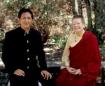 Pema Chodron: What would you say, in a nutshell, that we should do about the confusion?
Dzigar Kontrul: Listen to the teachings, study them, and contemplate them. Then, allow the teachings to illuminate your experience, rather than trying to bring your experience in line with the teachings. It’s important first to have the teachings illuminate your experience, so you can see what’s happening clearly before you actually try to put them into practice.
—from the Shambala Sun interview, January 2006
Here Pema Chodron is asking about the universal confusion experienced by all of us regarding our true nature. It’s the confusion that causes us to constantly feel alienated and unfulfilled. It’s our habitual pattern of judging all our experiences as good, bad, or indifferent, and the accompanying suffering that unfolds as a result.
I love Dzigar Kongtrul Rinpoche’s response. He takes it for granted that we know what the teachings on liberation say and how to access them. The power in his answer is that he warns us not to use them as a yardstick to judge ourselves, which would just be an extension of our confusion. I appreciate this, because self-judgment is a major afflictive emotion for me, and I often get frustrated with spiritual practice because I judge myself unsuccessful at living out the teachings that I know can set me free.
What I hear Rinpoche saying is that we should just look at our minds, and calmly watch the patterns of experience unfolding in our minds, and see how those experiences compare to the teachings. Do the patterns in my mind confirm what the sages of old have been saying down through the centuries? When I experience moments of clarity, what are the causes and conditions that give rise to the clarity? In this simple approach to practice, we become scientists dispassionately observing our subject, watching its behavior, drawing conclusions and learning from the present moment as each moment unfolds. There is no struggle; just continuous learning.
Saturday, December 24, 2005
Friday, December 23, 2005
The Birth of Something Different
Into this world
this demented inn,
in which there is no room
for Him at all,
Christ has come uninvited.
But because He cannot
be at home in it, because He is
out of place in it,
His place is with those
who do not belong,
who are rejected
by power because
they are regarded as weak,
those who are discredited,
who are denied
the status of person,
tortured and exterminated.
With those for whom
there is no room,
Christ is present in this world.
He is mysteriously present
in those for whom
there seems to be nothing
but the world at its worst.
--Thomas Merton
Some people professing to follow Christ have made a big deal out of people saying "Happy Holidays" this year instead of "Merry Christmas." These folks would do well to read Thomas Merton's poem and be reminded of what following Christ really entails.
this demented inn,
in which there is no room
for Him at all,
Christ has come uninvited.
But because He cannot
be at home in it, because He is
out of place in it,
His place is with those
who do not belong,
who are rejected
by power because
they are regarded as weak,
those who are discredited,
who are denied
the status of person,
tortured and exterminated.
With those for whom
there is no room,
Christ is present in this world.
He is mysteriously present
in those for whom
there seems to be nothing
but the world at its worst.
--Thomas Merton
Some people professing to follow Christ have made a big deal out of people saying "Happy Holidays" this year instead of "Merry Christmas." These folks would do well to read Thomas Merton's poem and be reminded of what following Christ really entails.
Thursday, December 22, 2005
What is Heaven?
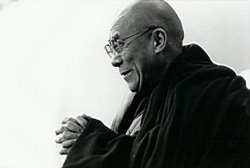 I knew it would be frustrating, but nevertheless I felt a compulsion to watch Barbara Walter's television special on Heaven the other night. The draw for me, of course, was that she planned to interview His Holiness the 14th Dalai Lama, exiled leader of Tibetan Buddhism.
Walters actually did a pretty good job of having a lot of different religious viewpoints represented, but I was frustrated that the messages we heard from so many of the clergy, whether Jewish, Christian or Muslim, was that our popular images of heaven ought to be taken literally. They didn't say this specifically, but it was clear that they did indeed take all the typical images of the afterlife at face value. I was disappointed that no contemplative perspectives were offered which would say, "Perhaps these images that we have inherited from previous generations who have speculated on the afterlife are far too limited to really convey the reality of what lies beyond this life?" Maybe we talk about streets of gold, or heavenly mansions, or being reunited with our loved ones, because these are the best images we can come up with using our limited human minds to describe an experience beyond words and description?
For example, many of those interviewed expressed their belief or desire to be reunited with their loved ones after death. I long for that as much as anybody, but perhaps that reunion is far vaster than what we typically imagine. What if there will be a time when we can know our loved ones far more intimately than we have ever known them here, when all of the barriers, whether physical, psychological or spiritual, will be broken down, and we can see each other the way God sees us? And better: what if we can see every other being who has ever lived at this same intimate level? What if we could experience the love of every being at a level exponentially greater than anything we've ever experienced on earth? Basically, we would experience the vast interconnectedness of all life without the barriers of "self." We would not just "see" each other in heaven, we would know all others on a level beyond anything before, so that we experience only Knowing and Being?
In Walters' interview, the Dalai Lama expressed the traditional Tibetan belief that "heaven" is actually part of the six different realms of existence, and that it is a place of peace and comfort similar to what the theistic traditions describe. However, he was careful to point out that "reaching" heaven just means we can continue our spiritual journey with fewer of the hindrances and obstacles of this realm. The point is not being someplace, but being a particular way. Again, the point is the experience of interconnection, compassion and understanding. This will of necessity require us to let go of all images, concepts and ideas that we have clung to, including our ideas of heaven.
Subscribe to:
Posts (Atom)


 Posts
Posts

