Showing posts with label Monk Who Dwells in Daily Life. Show all posts

Sunday, December 18, 2005

Monastic Humor

“There was a man in our [monastic] community who was always prompt, studious, generally serious, and obviously destined for a role among the hierarchy. He was a perfect target for monastic humor.

One night he arrived at his room to find life-sized statues of a male and female saint lying next to each other in his bed. On another occasion, just to add a spice of humility to his habit of promptness, some of his more thoughtful confreres unscrewed the handles on his door, so that when the bell for vespers rang, no matter how much he tried, he couldn’t get the door open.

What is the humor within the joke here? Don’t saints sleep together? Don’t we know from Pygmalion that statues have their own private lies? Aren’t we always locked in when we have important things to do elsewhere?”
—Meditations on the Monk Who Dwells in Daily Life

We want our lives to be so neat and tidy. We want everything to fit, and nothing to be ambiguous, messy and certainly not flawed. But enlightened living is not having it all together. It’s seeing that it’s all a big mess, and being able to embrace the mess with humor and with love.

Friday, December 16, 2005

Sacred Time

"In monastic life time is not measured by a clock. The day may be set out according to the parts of the Divine Office, a set of psalms and songs chosen according to the remembrance of the day--a saint, a liturgical season, a holy event...Qualities of time are also evoked by chants...We all have music that is tied to special times, and is therefore a means for celebrating the seasons of the soul. We could all learn from monks to disregard our watches and find other more imaginative, creative ways to mark time."
--Meditations on the Monk Who Dwells in Daily Life

Perhaps the most unique and fascinating alternative to our normal way of marking time that I've ever encountered is the ECOlogical calendar, which was developed by artist Chris Hardman. Reflecting the theory of All Time, the ECOlogical calendar is a colorful, poetic and extremely naturalistic tool for marking our place in the history of the universe. On the ECOlogical Calendar, years are marked since the dawn of the universe approximately 13.7 billion years ago (that will put things into perspective). Names of the months and days of the year are given poetic names that reflect the astrological, geological and ecological phenomena that are nature's holistic signposts marking the changes of the seasons. My birthday, for example, which is on Jan. 4 on the Gregorian calendar, occurs in the month Celeste and is called "Sunclosest" in the ECOlogical calendar, reflecting the ironic phenomena that though the Northern hemisphere is cold and dark this time of year, the Earth's actual proximity to the sun is relatively close (it's the tilt of the Earth that creates the seasons; in that sense, I guess the ECOlogical calendar does reflect a Northern hemisphere bias!).

At any rate, tools like the ECOlogical calendar are useful for reframing our normal way of viewing time and nature, and help correct centuries of anti-environmental sentiment that the world's religions have unfortunately reinforced. With their emphasis on the impermanence of the physical world and the afterlife, the great religions have often left believers with a sense that nature is unimportant, even fallen or corrupt. The Franciscans offer a long-standing alternative to this anti-nature attitude, emphasizing the sacredness and sacramentality of the physical world. Such a perspective will be essential if Christian practitioners hope to maintain a relevant place in this rapidly-changing environmental context, and a relevant and centered view of humanity's place in universal time.

Wednesday, December 14, 2005

Bells of Mindfulness

“Mundane withdrawal from the busyness of an active life can create a spirituality-without-walls, a spiritual practice that is not explicitly connected to a church or a tradition. I have never forgotten Joseph Campbell’s response when he was asked about his daily yoga practice: laps in a pool and a drink once a day. Anything is material for retreat—cleaning out a closet, giving away some books, taking a walk around the block, clearing your desk, turning off the television set, saying no to an invitation to do anything.

At the sight of nothing, the soul rejoices.”
—Meditations on the Monk Who Dwells in Daily Life

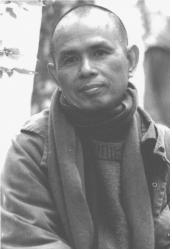
Perhaps the greatest modern saint of simple, mindful living is Thich Nhat Hanh, the Vietnamese Buddhist monk who was nominated by Martin Luther King, Jr., for the Nobel Peace Prize. Since the end of the Vietnam conflict, Thay, as he is called by his students, has written dozens of books and become the world’s ambassador for mindfulness.

Thay recommends very simple practices for waking up the present moment. One of his easiest strategies is to try to utilize normal, everyday sounds as “bells of mindfulness.” When we hear these sounds, we are encouraged to stop whatever we are doing, take a moment to smile and breath, and absorb whatever is going on around and within us. The ringing of the telephone, for example, instead of sending us scrambling to respond to yet another demand, can become our bell of awakening, and we can momentarily resist the urge to answer, collect ourselves back into the present moment, and then pick up the phone with compassion, wisdom and understanding.

There is a doorbell at my place of work that automatically rings when visitors enter the building to alert the staff that someone has arrived. It rings several dozen times a day. Thich Nhat Hanh would probably point out the reliability of this bell of mindfulness, and encourage me to use it for mini, instant retreats whenever I need to return to the present moment.

Tuesday, December 13, 2005

The Soul at Work

“Monastic buildings show us how an intense interior life may generate an outward form of art, craft, and the care of things. Out of a simple life has come an extraordinary heritage of books, illuminated pages, sculpture, architecture, and music. The cultivation of the inner life overflows in outward displays of beauty and richness.

Maybe it’s a mistake to think of the monastic life as a withdrawal from the active world. We might see it more as an alternative to the hyperactivity that is characteristic of modern life. Traditionally, the monk is extremely active, and on many fronts: actively engaged in nurturing the inner life, actively committed to a communal style of living, and actively producing words, images, and sounds of extraordinary meaningfulness and beauty.”
—Meditations on the Monk Who Dwells in Daily Life

It seems such a stretch for me to imagine cultivating more awareness, more soulfulness, and more meaning out of my work life. My work environment seems the antithesis of monastic thoughtfulness and care. Home life, on the other hand, seems richly soulful to me. It is here at home that I am surrounded by the symbols that give my life meaning, by relationships that nourish and recreate me, where I can nurture little rituals of mindfulness, gratitude and joy.

It’s no wonder we feel so alienated and disconnected every day, when such a wide gulf exists between work and home. Is it just me? Does everyone feel this chasm? I think many do, and it accounts for the fragmentation and unease we experience regarding our work lives.

This is a challenge we must take up. We must find intentional ways to bring soulfulness and meaning back into our vocations and our workplaces. But I hardly know where to begin. To even use this kind of language at work seems slightly embarrassing. What will others think of me? Will they think I’m some kind of religious kook? What kind of strange looks and comments would I get if I closed my door every day and hung a sign that said, “Please do not disturb; meditation in progress”? And the truth is, in my work environment, which is so crisis-oriented, I fear I could not respect my own commitment to “soul time” even if others did. I’m lucky to even have a door to close. In many workplaces you’d have to go to the bathroom to get a minute’s worth of solitude.

I don’t know the answers, for myself or others. But I do know that we need to ask this question in an intentional, deliberate, and thoughtful way. Work is killing us, when it should be cultivating great joy and meaning in our lives. Perhaps today I will start with a tiny little experiment, one I’ve tried in the past with some success, when I can remember to do it. Today I will endeavor to slow down my pace (the speed of my physical activity as well as my thoughts) a mere ten percent. Reducing the pace ten percent actually takes far greater mindfulness than reducing it by half or coming to a complete stop. What I sometimes find is that in doing so, I can increase my productivity by more than ten percent, although that’s not the point. We’re not trying to become more productive; we’re trying to become happier, more holistic human beings.

Monday, December 12, 2005

Tending the Culture of Emptiness

Early Christian monks went out to live in the desert in order to find emptiness. Modern life is becoming so full that we need our own ways of going to the desert to be relieved of our plenty. Our heads are crammed with information, our lives busy with activities, our cities stuffed with automobiles, our imaginations bloated on pictures and images, our relationships heavy with advice, our jobs burdened with endless new skills, our homes cluttered with gadgets and conveniences. We honor productivity to such an extent that the unproductive person or day seems a failure.

Monks are experts at doing nothing and tending the culture of that emptiness.”
—Thomas Moore, Meditations on the Monk Who Dwells in Daily Life

I don’t remember when I first became enamored with monks and the monastic life. It must have been in college, because I had no personal or cultural reference point earlier than that. When I became interested in Thomas Merton and in Buddhism, I quickly sought out monks and monasteries to see for myself what that life was all about.

Perhaps what has fascinated me the most over the years about the monastics I’ve come to know is how wonderfully human they are. Like me or you in every other way. What makes them different is their deep intentional commitment to live out of that space of emptiness within, to honor silence and solitude as the ground of a healthy, spirit-filled life.

Thomas Moore is best known for his many books on caring for the soul, but this little volume, Meditations on the Monk Who Dwells in Daily Life, is without question my favorite. In it, Moore reflects on the twelve years he himself lived as a monk, and the way in which his daily life is still shaped by that experience of “doing nothing.”

My prayer today, for you and for me, is that with grace, nothing will happen.