"Parallel waves of sunlight falling on a piece of paper will do no more than warm the surface. But that same amount of light, when focused through a lens, falls on a single point and the paper bursts into flames. Concentration is the lens. It produces the burning intensity necessary to see into the deeper reaches of the mind."
--Bhante Gunaratana, Mindfulness in Plain English
Whenever I start working with the basic mechanics of meditation, there is no better resource than this little book by the Sri Lankan monk Henepola Gunaratana, abbot of the Bhavana Society monstary in West Virginia. Several years ago I had the chance to do a metta retreat with Bhante G at Bhavana Society, and last year sat a five day retreat with his former student Matthew Flickstein.
There are two qualities of mind that we cultivate in medation: concentration and insight. They function in tandem, as Bhante G explains in the passage from which the quote is taken. In my own practice, I am focusing once again on concentration, and I see the afflictive states of mind emerge in even this most basic function. When concentration wanders, I've begun to notice the subtle but deep way in which I berate myself for losing concentration. This is foolishness, as the nature of the mind is to wander and grasp. It would be like berating our ears for noticing sounds. Yet, this is what the mind is doing, so I cannot judge the judging, either. So, I am bringing mindfulness to the judging, but using concentration to quickly refocus the mind back into the present moment. The judging is a way of clinging, and when we truly return full-force to the present, the clinging is broken for a time and the mind can rest.
Showing posts with label Meditation. Show all posts
Showing posts with label Meditation. Show all posts
Friday, January 06, 2006

Tuesday, January 03, 2006
Back on the cushion
 I am formally meditating again, as regularly as I can. Not sure what triggered the motivation to get back on the cushion, but it’s probably just the cycle of interest that has contributed to my on-again, off-again practice for the last dozen years or so. I have felt my understanding of the practice, and of my own mind, open up considerably in the last year. I had some breakthrough moments on retreat last spring. Just the memory of that little glimpse of clarity has stayed in the back of my mind ever since, gently, quietly calling me back.
Self-judgment is a dominant theme in my practice, though it took me years to see it. I kept judging myself as a failure because I wasn’t getting free of all my hang-ups. This, even though I knew good and well that the practice is not about getting rid of hang-ups. Nevertheless, I judged myself for being so messed up, I quit sitting numerous times because I felt so miserable. I finished each meditation feeling worse about myself. In a particularly sad way, I turned the practice into just another method to beat myself up. Finally, a moment emerged when I saw the judging for what it is: another impermanent phenomenon of the mind. When I started just watching the judging arise and pass away, it lost most of its power. Still, two years after this realization, sometimes I tremble at its tremendous force when it rises up in the mind.
It has helped to view meditation as an act of compassion toward myself, a way of loving myself more. I try to see the act of watching the mind as compassion itself, embracing and letting go of everything that is “me.” This compassion, in turn, has encouraged self-confidence. The little hassles of the day and the little stumbles I make seem puny and unimportant in comparison with the vast, luminous Buddhanature from whence it all arises. There is nothing I cannot handle from this perspective.
I have tried especially to peer into the constantly discriminating element of the mind, which is the generic energy that makes up the self-judging faculty. The dualistic mind judges every experience as good, bad, or indifferent. Catching the mind and watching it dispassionately while it goes through this judging cycle helps loosen its grasp and dominance. I am also continuing to experiment with “choiceless awareness” practice, which is the radical meditative technique Matthew taught us last year on retreat that involves not meditating on anything, but just watching. My concentration seems pretty weak for this practice, though, so I should probably devote more energy to focusing the mind first. I just find myself so eager to “just sit,” the concentration practice seems to get in the way. Just need to watch that too….
Tuesday, December 27, 2005
Applying the Teachings
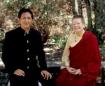 Pema Chodron: What would you say, in a nutshell, that we should do about the confusion?
Dzigar Kontrul: Listen to the teachings, study them, and contemplate them. Then, allow the teachings to illuminate your experience, rather than trying to bring your experience in line with the teachings. It’s important first to have the teachings illuminate your experience, so you can see what’s happening clearly before you actually try to put them into practice.
—from the Shambala Sun interview, January 2006
Here Pema Chodron is asking about the universal confusion experienced by all of us regarding our true nature. It’s the confusion that causes us to constantly feel alienated and unfulfilled. It’s our habitual pattern of judging all our experiences as good, bad, or indifferent, and the accompanying suffering that unfolds as a result.
I love Dzigar Kongtrul Rinpoche’s response. He takes it for granted that we know what the teachings on liberation say and how to access them. The power in his answer is that he warns us not to use them as a yardstick to judge ourselves, which would just be an extension of our confusion. I appreciate this, because self-judgment is a major afflictive emotion for me, and I often get frustrated with spiritual practice because I judge myself unsuccessful at living out the teachings that I know can set me free.
What I hear Rinpoche saying is that we should just look at our minds, and calmly watch the patterns of experience unfolding in our minds, and see how those experiences compare to the teachings. Do the patterns in my mind confirm what the sages of old have been saying down through the centuries? When I experience moments of clarity, what are the causes and conditions that give rise to the clarity? In this simple approach to practice, we become scientists dispassionately observing our subject, watching its behavior, drawing conclusions and learning from the present moment as each moment unfolds. There is no struggle; just continuous learning.
Subscribe to:
Posts (Atom)


 Posts
Posts

